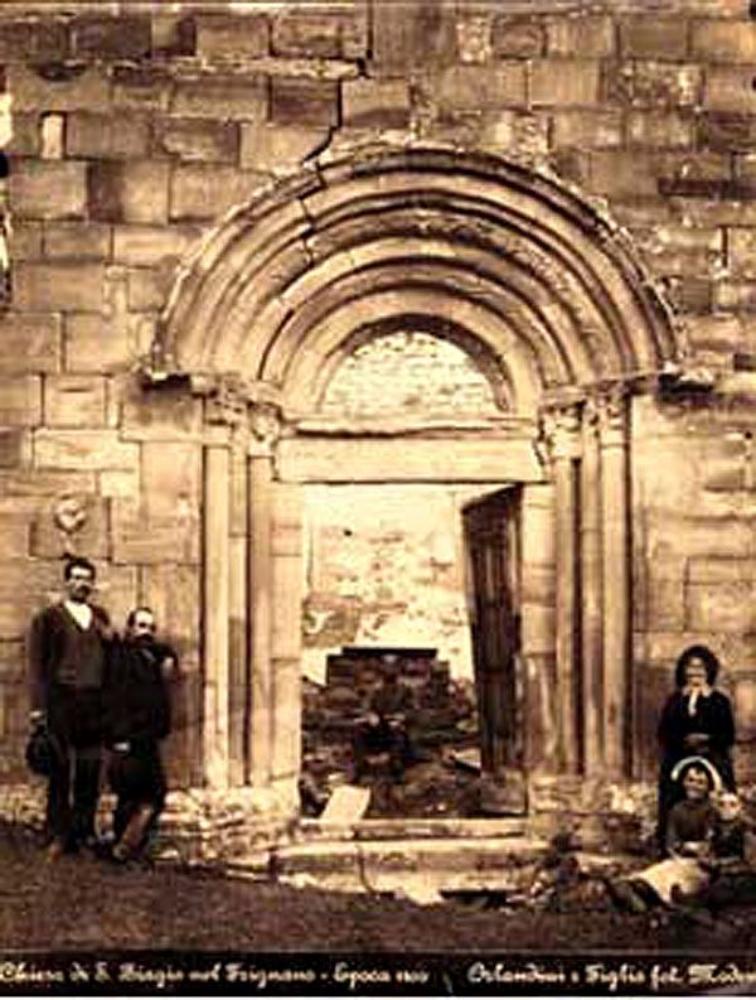


Le Raccolte Fotografiche Modenesi, fruit of the intense collecting activity of Giuseppe Panini, offer an extraordinary visual heritage consisting of images created by Emilian authors between 1860 and 1950 and from entire photographic and documentary collections of different origins, starting with the material from the Modenese studios Orlandini, Bandieri, Giberti, whose activity lasted over a century. For completeness and variety, the postcard collection is also noted, one of the largest existing collections for the Modena area and province, and the Aeronautical Collection, where images and documents of pioneering aeronautics up to the end of the First World War are preserved. The Collections also have a library with about 4,000 volumes and ancient and modern essays on Modena, its province and, more generally, on photography. It also includes a periodicals library that holds newspapers published in Modena from the late 18th century until the 1950s and a large collection of specialized newspapers and magazines.
In the permanent exhibition, original equipment and furnishings recreate the atmosphere of early twentieth-century photographic studios and illustrate how work was conducted in the Modenese workshops. In particular, the reconstruction of the Orlandini studio is presented again, the most important and long-lived among the Modenese photographic studios, opened around 1879 by Pellegrino, who had previously worked as an itinerant photographer. Through a gallery of portraits selected from the Collections’ own archives, the journey continues revisiting the history of photography from the first daguerreotypes to color printing, to capture the evolution of fashion and customs and highlight the changes that took place over a century and a half, with the development of new techniques and various supporting materials. Urban and territorial transformations are also documented in a permanent exhibition section that narrates, in its key moments, the urban history of the city of Modena and its province.
Completing and enriching the reconstruction of the evolutionary path of the shooting techniques is a series of cameras constituting the instrumental equipment of the three photographic studios mentioned above. Finally, of particular significance are the temporary exhibitions of absolute historical and artistic value, realized in collaboration with other institutions from the world of photography and art throughout Europe, such as the exhibition “New York In and Out. The city of American photographers and Ferruccio Testi. 1880-1915” (2008), “Jindrich Štyrský. On the Needles of These Days” (2009), “Japan Contemporary” (2010) and “Yasuzo Nojima. A master of the Land of the Rising Sun between pictorialism and modernism” (2011), the first Italian retrospective dedicated to the master of Japanese pictorial photography. Among other exhibitions are: “I Sorgato photographer entrepreneurs. The Modenese studio” (2008), “The revealed mountain. 19th-century photographs from the Fineschi collection” (2009), “The games never seen” (2009), “Ethos of Italians – 1950s. Modena and the Italy of rebirth” (2009), “The days and places. The Educatorio San Paolo of Modena” (2010), “Salvatore Andreola and pictorialism” (2010), “1960s Modena and the Italy of the boom” (2010) and “Qajar Persia 1848-1864. Italian photographers in 19th-century Iran” (2010).
Information about Fotomuseo Giuseppe Panini
Via Giardini, 160,
41121 Modena (Modena)
059224418
[email protected]
https://www.fotomuseo.it
Source: MIBACT