

Se anche tu ami la France et que vous souhaitez profiter de ses merveilles en quelques jours, nous vous proposons un itinéraire qui explore le sud de la France en sept jours. Une véritable découverte du territoire français dans la partie méridionale du pays transalpin. En alternative, vous pouvez choisir un itinéraire dans la France romaine du sud.
Prêts à vous immerger parmi les couleurs et les parfums de ces régions ? Voici le programme pour profiter des plus beaux endroits.
South France Itinerary
The first town, Nice, is a well-known summer holiday destination since past centuries, periods when nobility from all over the globe chose this area to spend their vacation. The town still retains a royal and princely appearance and offers a wide variety of attractions for both adults and children. You can choose between a visit to one of the famous museums hosted by the city or a stroll along the Promenade des Anglais, rich with stretches of crystalline sand. Nice is full of places where you can enjoy royal meals and taste local typical dishes. Moving inland, you reach the town of St. Paul de Vence: this is a village rich in medieval history, a famous place where both Signac and Modigliani found inspiration for their masterpieces. Heading down to the coast, we find Antibes: a port town always hosting row after row of moored boats and a very rich museum, the Musée Picasso. Afterwards you can reach the hill where Grasse is located, the world’s perfume capital since the 1600s.
After a quick stop at the Fragonard and Molinard perfume museums, we say goodbye to the town of Grasse with its endless fields of mimosa and lavender, and after about 80 km, we reach Saint Tropez, passing through Cannes. Despite its fame, Saint Tropez has remained a fishing village, once very rich in fishing boats, now diminished due to the advent of very luxurious yachts.
About 200 km by highway from Saint Tropez lies the characteristic town of Avignon. Upon arrival, it is advisable to park the car in the space reserved for the city center and walk up to Place du Palais. In the square, from which it takes its name, stands the Palace of the Popes, the building where the papacy was transferred from 1309 to 1377. The visit to the Palace of the Popes requires at least a couple of hours. The center of Avignon is rich with imposing 14th-century walls and hosts cathedrals and historic buildings that are definitely worth visiting.
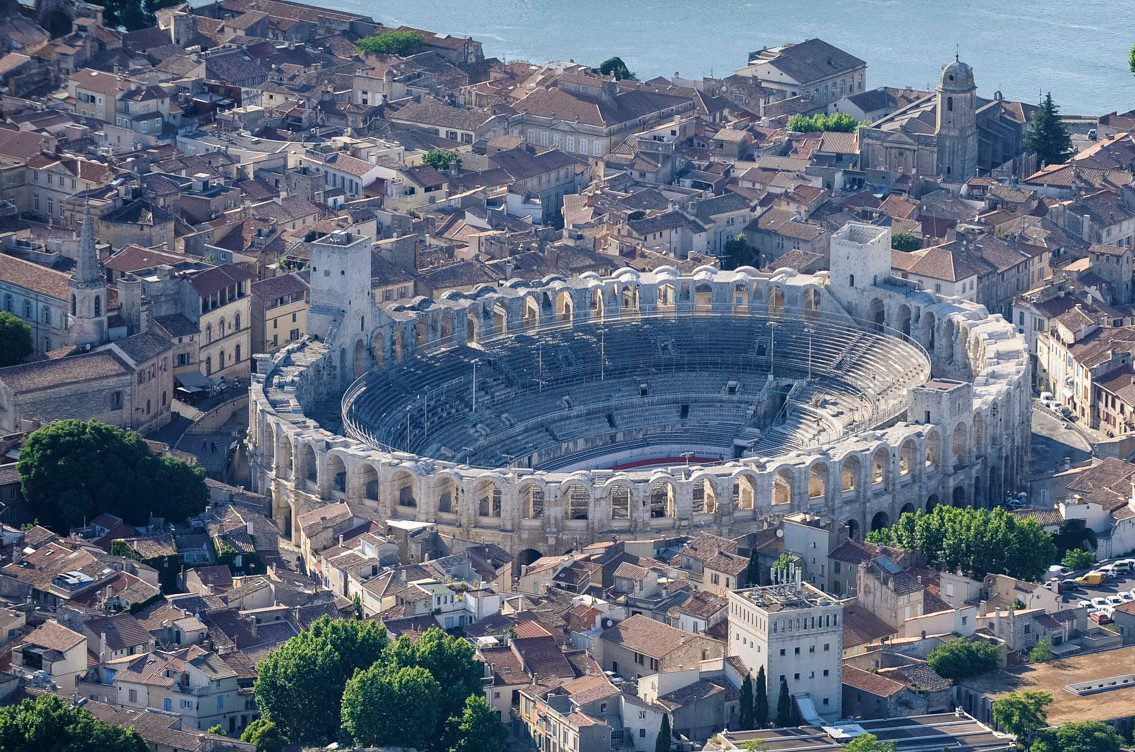 Panorama of Arles, in the south of France
A city 36 km from Avignon, lies the town of Arles. It is a World Heritage Site and hosts a wonderful Roman amphitheater, almost intact over time. Then, after a few kilometers, you reach the town of Camargue. It presents itself in a striking way with marshes, expanses of sand, salt flats, and the presence of animals such as flamingos, white horses, and bulls, all animals living according to a perfect ecological balance. The area hosting all of this is truly vast: it covers 820 square kilometers.
About a couple of hours from Camargue lies Sète, a port town less known to tourists but ideal for a stop in one of the local restaurants. After enjoying a good meal, you can head to Béziers and admire the Cathedral. About 90 km away lies Carcassonne, a city surrounded by well-preserved Gallo-Roman walls and bastions. Ideally, you would visit the medieval village and dine in one of the restaurants overlooking the Basilica of St. Nazaire.
Defined by some as the most important town in southern France, Toulouse hosts one of the largest aerospace industries. About 90 km from Carcassonne, Toulouse hosts the wonderful Place du Capitol, especially known for the great variety of restaurants ready to seduce you with their typically regional culinary specialties.
We proceed north and reach Albi. The town is best visited very early in the day; otherwise, it is better to “take refuge” in the city’s museums to escape the hottest hours of the day. Crossing the Cahors bridge and the green lung of Perigord, you reach Rocamadour. The town offers unique sensations: it not only venerates a 13th-century Black Madonna but is also entirely built on a rock, forcing tourists to walk with their noses up. Only in this way will it be possible to admire houses, basilicas, and chapels that appear to be one with the surrounding rock.
You just have to choose where to stay and set off on an exciting journey to discover the beauties of southern France.