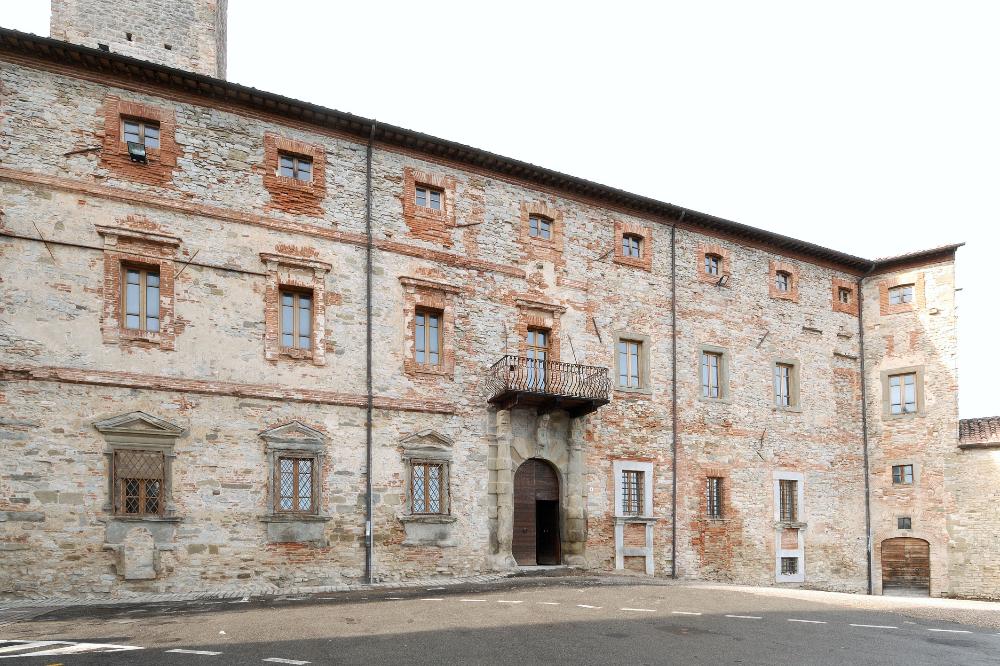
È incorporated in the basements of the seventeenth-century Bourbon-Sorbello palace located at the eastern end of Piazza Danti, at the foot of the highest part of the center of Perugia, called Monte di Porta Sole, corresponding in ancient times to the acropolis of the city.
It represents the most monumental of the city’s water infrastructure. Built in the Etruscan era with the dual function of well and cistern, it was placed along the main east-west road axis, which connected the Arch of the Lilies to Porta San Luca. Its visit is essentially complemented by that of the city walls, which offer further testimony of the urban development reached by Perugia in the Etruscan era.
Made with the same travertine as the city walls, it is carved into the so-called “almond-shaped block,” a typical conglomerate of the city. It consists of a cylindrical shaft over 30 meters deep, with a maximum diameter of 5.60 meters, narrowing to a funnel in the lower section. It has a roof formed by two trusses, each made up of four large travertine blocks, two horizontal and two oblique, supported by a central keystone. This system, which has close technical affinities with the cistern of Via Caporali located at the opposite end of the city, served to support a pavement of travertine slabs in which the water drawing mouth had to be fashioned. The work, whose centrality and monumentality leave no doubt about its public purpose, is dated to the 3rd century BC, based on technical similarities found with the city walls.
The maximum calculated capacity amounts to 424,000 liters, making it the largest among the various wells and cisterns of the city, also in use until the construction of the first public aqueduct in the 13th century.
Information about the Etruscan Well
Piazza Danti, 18
06121 Perugia (Perugia)
0755733669
[email protected]
https://www.comune.perugia.it
Source: MIBACT