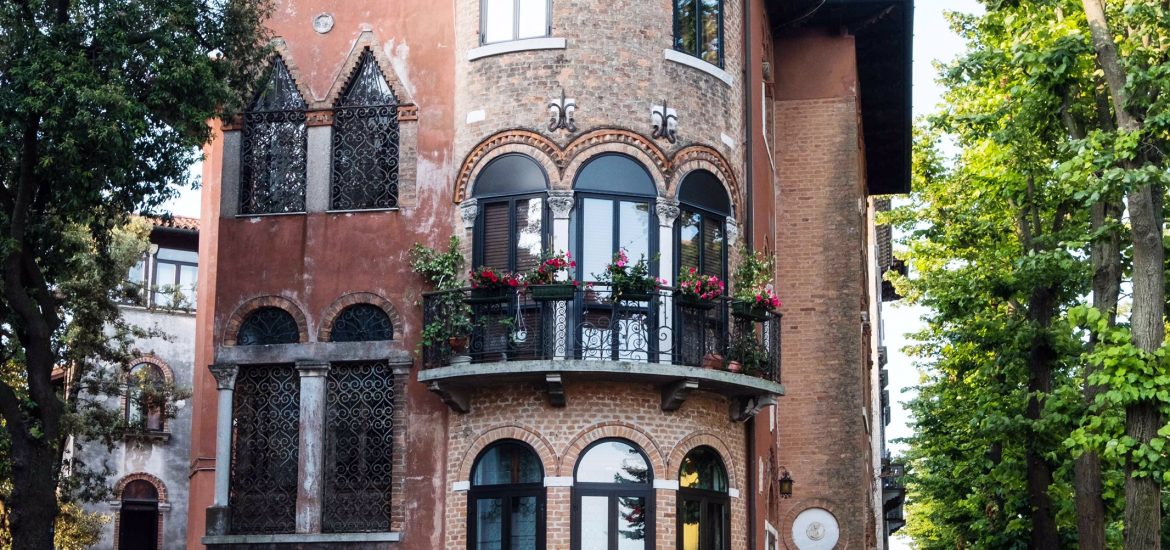



Il Piano Nobile is located above the famous Caffè Pedrocchi, built between 1826 and 1842 by Giuseppe Jappelli. The structure consists of a succession of rooms, each furnished and decorated to recreate the typical setting of a specific historical period. This creation is in line with nineteenth-century eclecticism, the taste and interest in past styles.
In 1816 Antonio Pedrocchi, son of a coffee maker of Bergamasque origin, with the intention of expanding his café and making it “the most beautiful on earth,” purchased a group of small houses located to the north of his property. The great Venetian architect Giuseppe Jappelli was commissioned for the project, who in 1826 began the works during which important architectural fragments from the Roman era were uncovered, now preserved at the Civic Museums at the Eremitani. Jappelli, transferring a secular and Enlightenment vision of society into architecture, made it his masterpiece, creating one of the city’s symbols. He solved the difficult problem of coordinating spatially different facades, resting on a roughly triangular area, building from the side of Piazzetta Pedrocchi two bodies with Doric loggias visually united by another Corinthian loggia on the piano nobile. The interior is articulated around the monumental and central red room with a hemicycle at the back, tripartite by Ionic columns and decorated on the walls by large maps. On its sides, symmetrically, open the white room to the south and the green room to the north corresponding to the loggias.
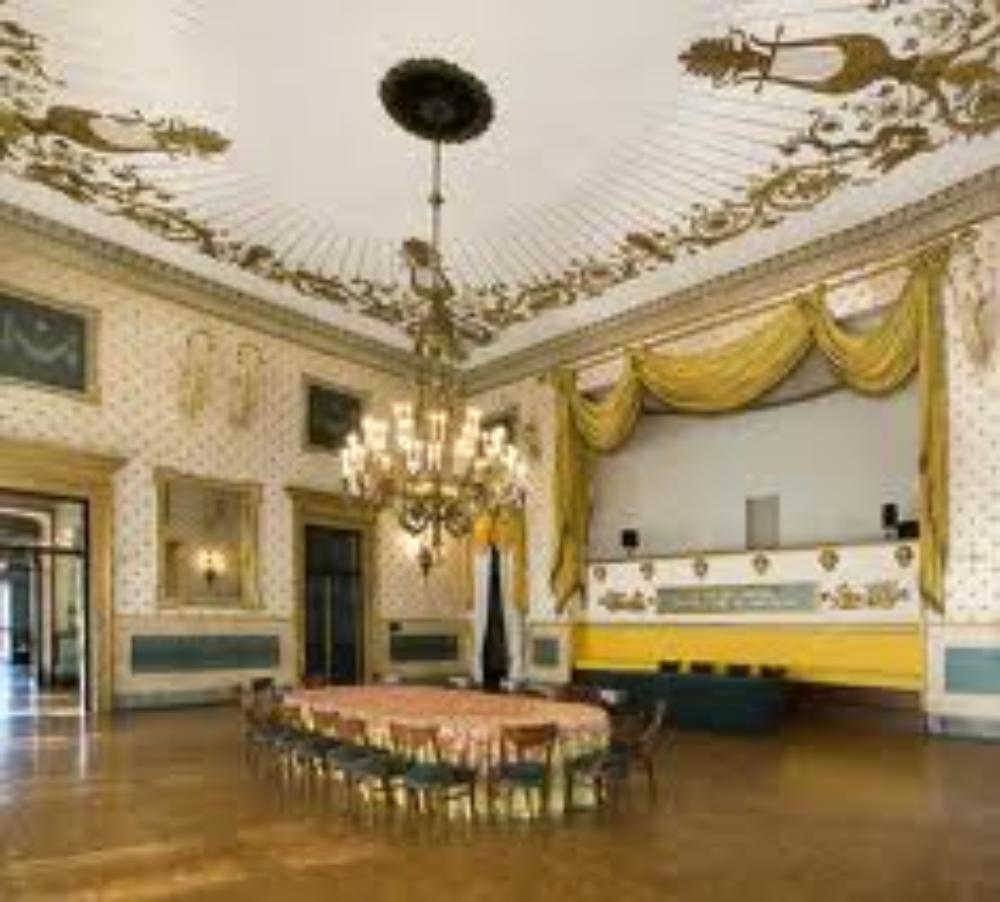
The upper floor was opened in 1842, on the occasion of the Fourth Congress of Italian Scientists and was conceived to serve as a reduced space. Its solemn entrance is located in one of the two loggias; the space opens with a grand staircase that ends in a niche decorated with stucco featuring the image of dancing Muses. All the rooms revolve around the ballroom dedicated to Gioachino Rossini, a large double-height space compared to the others, with dazzling Empire decoration, all praising music. A continuation of the Etruscan vestibule, and parallel to it, is the Greek room, decorated with a fresco by Giovanni De Min depicting the meeting between Diogenes and Plato. Following is a small circular room, the Roman room, decorated in 1841 by the Belluno artist Ippolito Caffi with Roman views: Castel Sant’Angelo, the Roman Forum and the Forum of Augustus, Trajan’s Column, perhaps the most interesting paintings of the entire complex.
To its left, the Renaissance room, with an unfinished ceiling painting by Vincenzo Gazzotto; part of the original furnishings is preserved here; on one side the room opens onto the terrace of the southern facade, on the other you enter the Herculaneum room, decorated by Pietro Paoletti with the Triumph of Diana on the ceiling, and on the walls with other episodes related to the myth of the goddess. On the opposite side of the ballroom is the Egyptian room, a tribute to the famous antiquities discoverer Giovanni Battista Belzoni, with whom Jappelli had personal contacts. The concatenation of these rooms intends to eclectically retrace the styles of the past, as moments of autonomous aesthetic appreciation in a revival climate.
In 1891 Domenico Cappellato Pedrocchi, adopted son of the founder Antonio, left the Café to the Municipality of Padua with the obligation to “preserve the use of the establishment ‘as found’ neglecting nothing so that it may maintain its primacy in Italy.”
Information on the Piano Nobile of the Pedrocchi establishment
Piazzetta Pedrocchi,
35100 Padua (Padua)
0498781231
info@caffepedrocchi.it
https://padovacultura.padovanet.it/musei/archivio/cat_sedi_civiche
Source: MIBACT