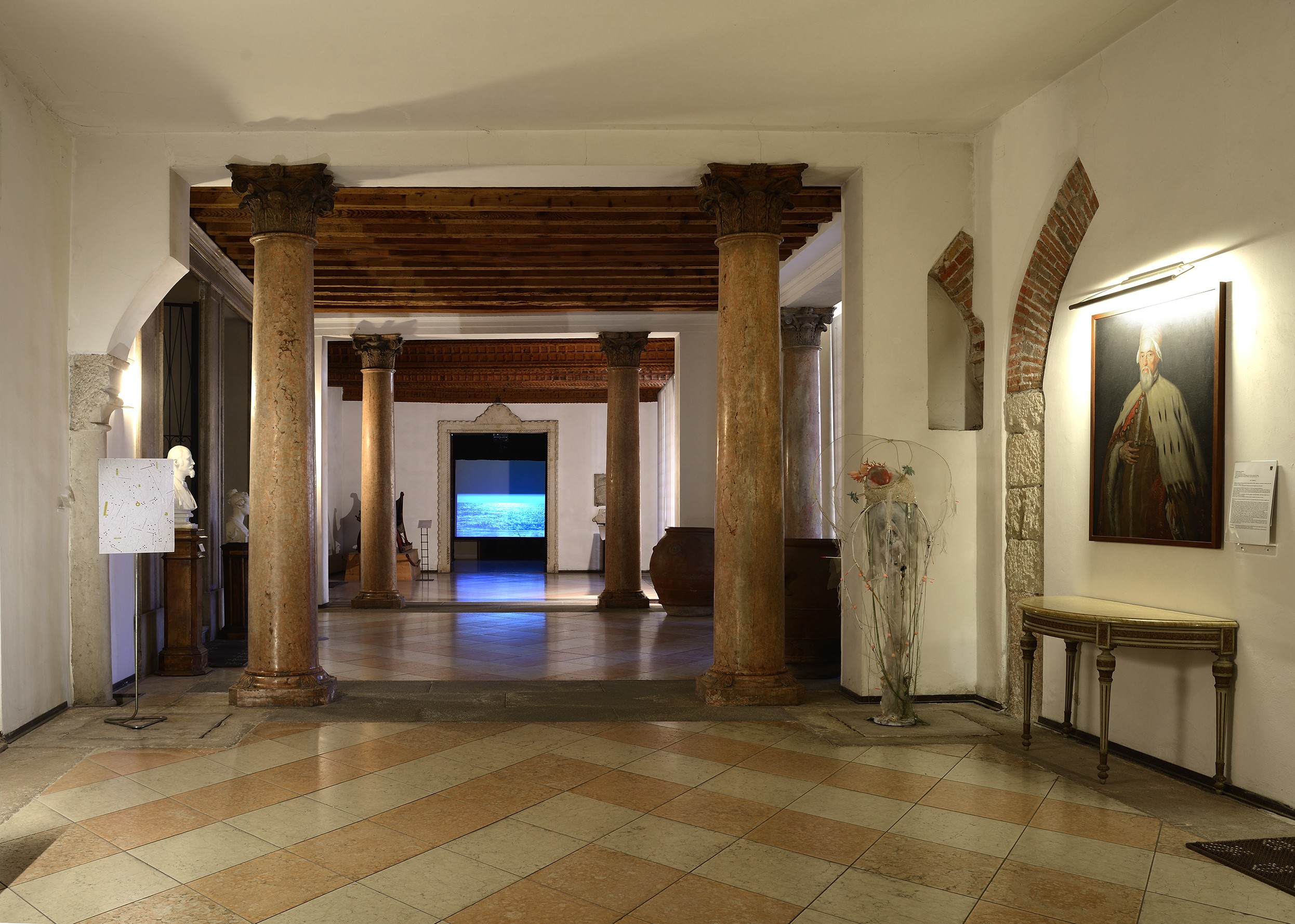
The large building stands along via Garibaldi, the main road that starts from the Railway Station and reaches the area of Pedrocchi and Bo, that is the heart of the historic center, and until recently it was the seat of the Italian Post Office. It overlooks the complex that includes the Roman Arena, the Scrovegni Chapel, and the Eremitani Museum: due to its location, it has been identified as the preferred destination for the expansion of the Civic Museums’ collections.
The Palace was built between 1912 and 1914 by the Milanese architect Arosio, in an still 19th-century style, commissioned by the industrialist Enrico Zuckermann. It can be considered one of the symbols of the new bourgeois city that arose between the end of the 19th century and the beginning of the 20th century, following the definition of the new privileged road axis leading to the station. It houses on the ground and first floors the new Museum of Applied Arts and, on the second floor, the Bottacin Museum. In the near future, the Palace is destined to accommodate, besides the museum exhibition rooms, a series of functions that cannot find a place at the Eremitani, such as catering. Spaces for bookshop, ticket office, and temporary exhibitions are planned.
Information about Palazzo Zuckermann
Corso Garibaldi, 33
35126 Padua (Padua)
049665567
[email protected]
https://padovacultura.padovanet.it/musei/archivio/cat_sedi_civiche
Source: MIBACT