

Il palazzo Trinci is located on the north side of Piazza della Repubblica, an ancient platea magna and the beating heart of the city of Foligno.
The most representative building of the city, it was built by the Trinci family and decorated by one of the greatest interpreters of the late Italian Gothic, Gentile da Fabriano.
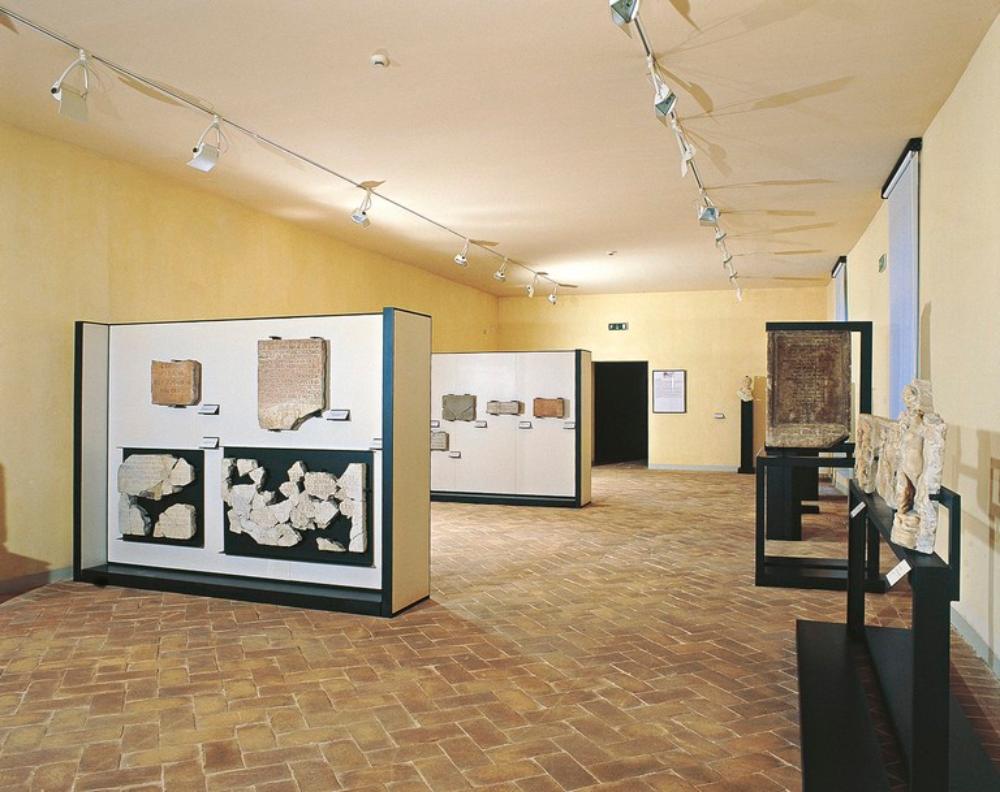
A visit is therefore mandatory to admire the rooms, the palace chapel, and the important archaeological and historical-artistic collections of the Museum, housed here since 2000.
Already the seat of the Trinci lordship, which governed the city from 1305 to 1439, it was built between the end of the 14th and the beginning of the 15th century by the will of Ugolino Trinci, renovating pre-existing medieval buildings and richly decorated.
With the end of the Trinci domain and the annexation of Foligno to the Papal States, the palace became the seat of papal governors, maintaining this function until the Unification of Italy, after which it was destined for offices. With the loss of its original function, the palace was variously adapted and modified also due to damage caused by the earthquake and the bombings of the Second World War. The construction of the neoclassical style façade dates back to the 19th century. The overpass on the right, which connected the palace with the houses built above the minor nave of the cathedral, preserves the brick facing with a bifora from the early 15th century. Other 15th-century architectural fragments are visible in the courtyard with a large brick portico and ribbed vaults.
The staircase on the right leads inside the palace, seat of the City Museum.
On the first floor is the Gothic staircase, once open-air, entirely decorated with geometric motifs. On the second floor opens a large vestibule, the Sisto IV hall, decorated with frescoes and ornamental and figurative motifs and covered by a wooden ceiling with the pontiff’s coat of arms in the center. At the end of the hall is the chapel frescoed by Ottaviano Nelli with Stories of the Virgin’s Life, dating back to 1424. In the nearby loggia are the Stories of the Foundation of Rome (part of the frescoes is limited to sinopia), which allusively relate the power of Rome and that of Foligno. From the loggia you access the hall of the Liberal Arts and the Planets, where the Arts of the trivium and quadrivium, philosophy, and the Seven planets are represented, linked to the Ages of Man and the Hours of the day. These personifications illustrate the complex allegorical concept according to which life is divided into seven periods, each influenced by a planet; to each age corresponds the learning of a discipline. The overpass-corridor connecting the palace with the cathedral also proposes the theme of the Ages of Man. The wall opposite is instead painted with the Heroes of Antiquity and the Champions of Medieval tradition. The Giants’ hall, accessed through an adjoining room to the hall of the Liberal Arts and the Planets, is frescoed with colossal figures of Heroes from the history of Rome, from Romulus to Trajan, dressed according to Renaissance fashion. Below the figures appear the respective names and Latin verses by the humanist Francesco da Fiano.
From the recent discovery of an 18th-century notebook, a transcription of an ancient document of 1411, it clearly appears that the work of the loggia, the hall of the Planets, the Liberal Arts, and the Giants was entrusted to Gentile da Fabriano with the collaboration of some pupils.
Information on Palazzo Trinci
Piazza della Repubblica,
06034 Foligno (Perugia)
0742/330584
museotrinci@comune.foligno.pg.it
Source: MIBACT