


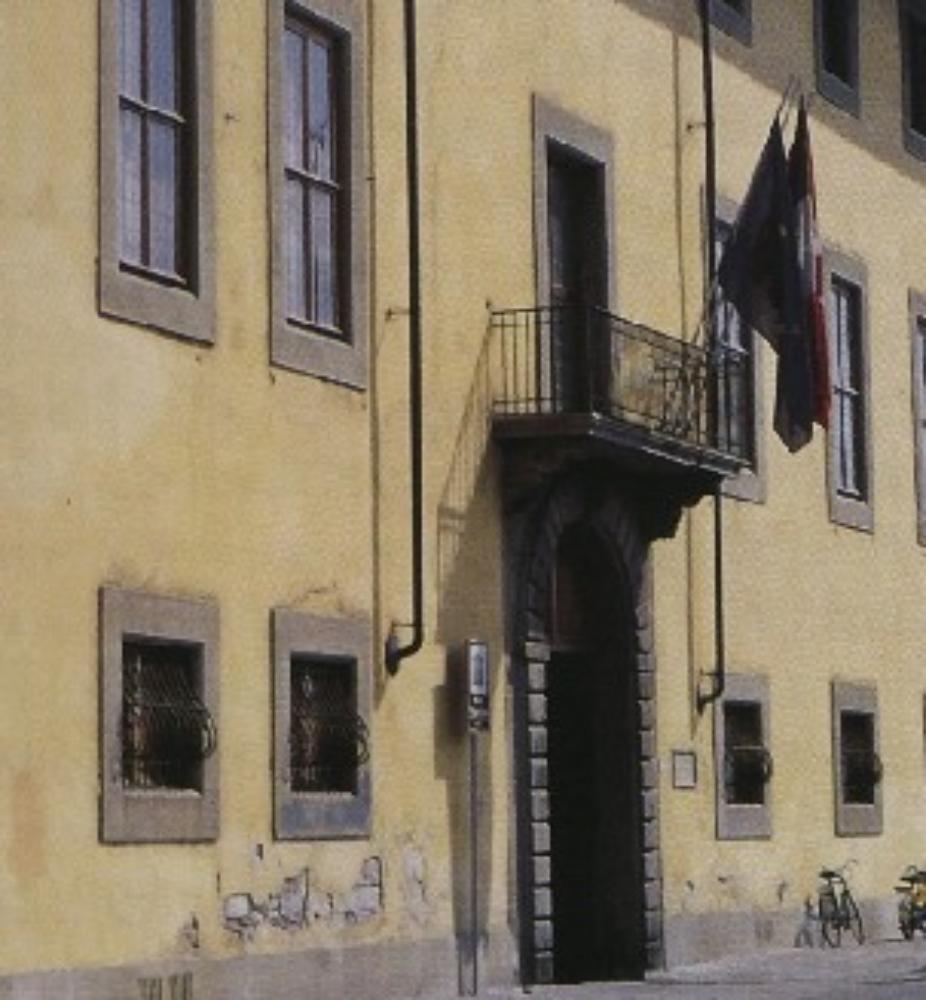

The Palace, whose construction between 1583 and 1587 is attributed to Francesco I de’ Medici, faces the Arno river on the front while at the back, through two large arches, it is connected on one side to the Church of San Nicola and on the other to the 13th-century House of the Widows. Currently also housing the Superintendency, it hosts the museum in the rooms of the noble floor. It documents the unfolding over time of an identical inclination to beauty of the ruling classes, from the Medici to the bourgeois collectors of the twentieth century. It displays the tapestries and furnishings that the Medici used to decorate the palace’s rooms. Among the portraits of the main representatives of the family (many from the collection of the Order of the Knights of Saint Stephen) notable effigies include Eleonora di Toledo, wife of Cosimo I de’ Medici (work of Bronzino) [Tapestry Room], Cosimo himself depicted with the grand ducal insignia (copy from the Flemish Justus Sustermans, the official portraitist of the family), and Ferdinando de’ Medici in cardinal’s attire (work of Alessandro Allori) [Room 7]. Other monumental portraits of the grand dukes [Room 8] are set alongside numerous portraits (works by Ferretti and Tempesti) of members of the Lorraine family that succeeded the Medici in ruling Tuscany and of two Sardinian kings, Vittorio Emanuele II and Umberto I [Room 11].
Of particular importance is the collection of ancient armaments from the Game of the Bridge, rich in over 900 pieces of Lombard manufacture from the 15th to 18th centuries [Room 6]. Among the private collections acquired in various ways, works attributed to Rosso Fiorentino (Rebecca at the well), the very young Raphael (the Miracle of the Two Hanged Men, part of the predella of the Triptych of San Nicola da Tolentino) [Room 12], Francesco and Luigi Gioli, and the very rich legacy of the surgeon Antonio Ceci with Italian and Flemish paintings, ivory miniatures, medals, porcelains, small bronzes, and drawings [Rooms 13-16] stand out.
Among the most recent acquisitions are paintings by Plinio Nomellini, Spartaco Carlini, Galileo Ghini, Mino Rosi, and Gianni Bertini.
Also exhibited are the very rich plaster cast collection and the paintings of Italo Griselli, among the major Italian sculptor-portraitists of the first half of the twentieth century [Rooms 17-21].
Cumulative ticket with the National Museum of San Matteo of Pisa: € 8.00 (full price) € 4.00 (reduced)
Information about the National Museum of the Royal Palace
Lungarno Pacinotti, 46
56126 Pisa (Pisa)
050 926573
[email protected]
https://polomusealetoscana.beniculturali.it/index.php?it/202/pisa-museo-nazionale-di-palazzo-reale
Source: MIBACT



