


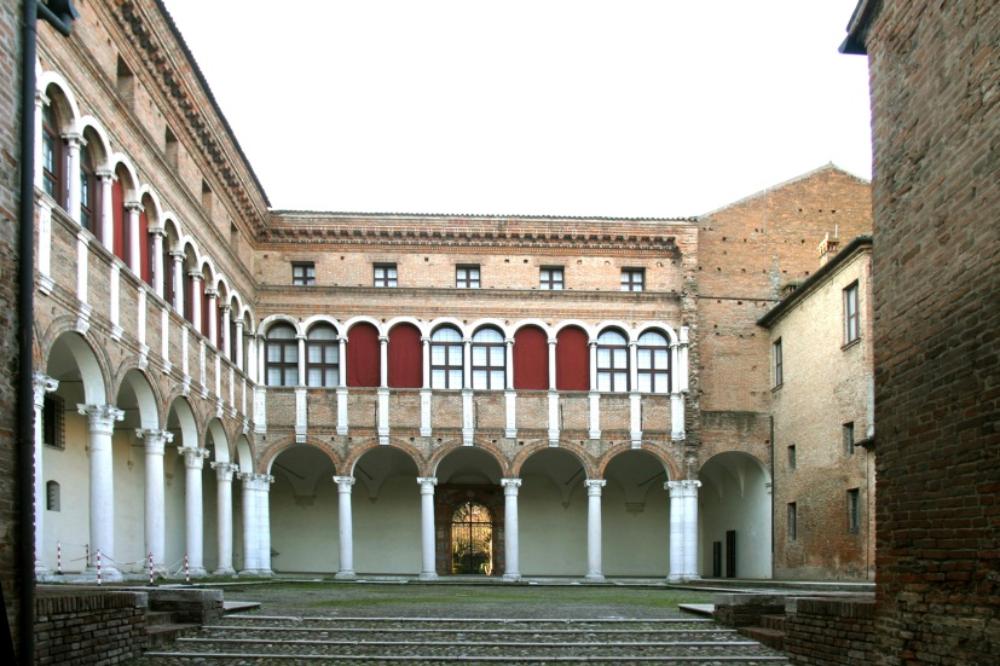

Housed in the palace designed by Biagio Rossetti for Antonio Costabili, the museum preserves the evidence of the necropolis and the settlement of Spina, the flourishing Etruscan commercial port that between the 6th and 3rd centuries B.C. was one of the focal centers of the region.
Some of the grave goods found in over 4,000 tombs are on display, artifacts of impressive beauty among which stands out an imposing collection of Attic red-figure vases from the 5th century B.C.
Recently expanded and rearranged with state-of-the-art exhibits, the museum boasts a “Treasure Room” frescoed by Garofalo, the Pirogues Room, single-log boats from the late Roman age (3rd-4th century A.D.), and the “Gold Room” with gold, silver, amber, and glass paste jewels dating back to the 5th and 4th centuries B.C.
On the ground floor, four rooms – two of which frescoed by Garofalo and his school – are dedicated “to the city of the living”, to the settlement of Spina, to cults and myths, to peoples and writings. The path ends with one of the “virtual libraries” that introduces the necropolis.
The main floor, in line with the original setup of the 1930s, is dedicated to the necropolis of the Etruscan city and features masterpieces of Attic vase painting, Etruscan bronzes, precious objects imported from all over the Mediterranean.
Some of the grave goods found in over 4,000 tombs are on display, artifacts of impressive beauty among which stands out an imposing collection of Attic red-figure vases from the 5th century B.C.
Recently expanded and rearranged with state-of-the-art exhibits, the museum boasts a “Treasure Room” frescoed by Garofalo, the Pirogues Room, single-log boats from the late Roman age (3rd-4th century A.D.), and the “Gold Room” with gold, silver, amber, and glass paste jewels dating back to the 5th and 4th centuries B.C.
On the ground floor, four rooms – two of which frescoed by Garofalo and his school – are dedicated “to the city of the living”, to the settlement of Spina, to cults and myths, to peoples and writings. The path ends with one of the “virtual libraries” that introduces the necropolis.
The main floor, in line with the original setup of the 1930s, is dedicated to the necropolis of the Etruscan city and features masterpieces of Attic vase painting, Etruscan bronzes, precious objects imported from all over the Mediterranean.
Information about the National Archaeological Museum of Ferrara
Via XX Settembre, 122
44100 Ferrara (Ferrara)
0532 66299
[email protected]
https://www.archeoferrara.beniculturali.it
Summer: from Tuesday to Sunday 9.30-19 (last admission 18.30) Winter: from Sunday to Thursday 9.30-17 (last admission 16.30), Friday and Saturday 9.30-19 (last admission 18.30)
€ 5.00
Source: MIBACT